
If you need to pull cash from a Texas home, the first question is usually not “What is the rate?” It is which tool you can use under Texas homestead rules — a home-equity line of credit or a cash-out refinance — and what that choice does to the loan you already have.
Both options can raise cash against equity. They are not interchangeable. A cash-out refinance replaces your current first mortgage with a larger one. A HELOC is typically a new lien, often in second position, that lets you draw and repay over time. In Texas, both have to clear homestead limits that do not apply in the same way in many other states.
The Texas rules that shape both options
Texas Constitution Article XVI, Section 50, is the starting point for homestead equity lending. For a home-equity loan under Section 50(a)(6), the total of all loans secured by the homestead generally cannot exceed 80% of the home's fair market value at origination. There is a 12-day waiting period after you apply and receive the required notice before you can close. Closings must take place at the office of the lender, an attorney, or a title company. These loans are typically non-recourse except in cases of fraud, and foreclosure generally requires a court order.
There is also a fee cap. For loans originated on or after January 1, 2018, required fees are limited to 2% of the original principal amount, with certain third-party charges — such as specified appraisal, survey, and title costs — excluded under the statute and 7 Texas Administrative Code §153.5. Texas also generally limits you to one home-equity loan of this type in a 12-month period.
A HELOC on a Texas homestead has additional requirements under Section 50(t). Those include extra consumer protections around draws and advances. The details belong in the required notices and in a loan estimate on your property, not in a national brochure.
None of this is a substitute for the official notices you will receive, and it is not legal advice. It is the reason a comparison that works in another state can fail, or need a different structure, in Texas.
An equity example, without inventing a HELOC rate
Suppose a home is worth $500,000 and the current first mortgage balance is $280,000. Eighty percent of $500,000 is $400,000. If the appraisal supports that value, additional equity lending would be limited to about $120,000 on top of the existing lien, before closing costs and program rules. If you only need $80,000, you may have room under the cap; if you need $150,000, the 80% test can stop the conversation regardless of credit.
Here is a cash-out refinance illustration if you replaced the $280,000 first mortgage and took $80,000 in cash, for a new first-lien balance of $360,000. Using the Freddie Mac 30-year average of 7.11% as of November 12, 2026, principal and interest on $360,000 would be about $2,421.74 a month. Taxes and insurance are extra.
We are not going to invent a HELOC annual percentage rate. HELOC rates are typically variable and are quoted separately from first-mortgage averages. The fair comparison is a same-day quote on both structures, including how each one treats your current first-lien rate.
That last point is often the deciding one. A cash-out refinance puts the entire new balance — the money you already borrowed plus the cash you are taking out — at today's first-mortgage rate. If your existing rate is lower than current market rates, you give that rate up. A HELOC can leave the first mortgage in place and add a second lien only on the new funds, which may cost less in interest if the first lien is already cheap, or more if the variable HELOC rate is high and you carry a large drawn balance.
When a cash-out refinance may fit
A cash-out refinance can be a fit when you want a single payment, a fixed rate on the full balance, and enough rate or term improvement — or a large enough cash need — to justify replacing the first lien. It can also make sense when you want to consolidate the equity loan and the first mortgage for simplicity, or when you expect to keep the loan long enough for the new payment to work.
It may be a poor fit when your current rate is well below today's averages, when you only need a modest amount of cash, or when you are close to paying off the first mortgage and do not want to restart a 30-year clock on the whole balance. If you are watching the market for a refinance anyway, set a target and compare the cash-out and rate-and-term paths side by side. We outlined that approach in how to set a strike rate and in five reasons to refinance your home in 2026.
Closing costs, Texas fee limits, and the 12-day wait all belong in that comparison. So does the possibility that a cash-out refinance is ineligible for some temporary payment features that a purchase loan might allow.
When a HELOC may fit
A HELOC can be a fit when you want to leave a lower-rate first mortgage alone, when the cash need is uncertain or will be drawn over time, or when you want the option to borrow only what you use. Remodeling, a staged project, or a reserve you may not fully draw are common examples.
It may be a poorer fit if you want a single fixed payment, if you are uncomfortable with a variable rate, or if the combined liens would approach the 80% cap and leave little room for costs or a value change. A line you can draw is also a line you have to manage. Unused capacity is not a reason to treat the house as a checking account.
If the goal is simply to build equity and pay the house off sooner, borrowing more is not the tool. For that path, see three simple ways to build equity and pay off your mortgage faster.
Taxes, timing, and what we will not decide for you
Interest deductibility is narrower than many homeowners remember. Under IRS Publication 936, interest on home-equity debt is generally deductible only if the funds are used to buy, build, or substantially improve the home that secures the loan, and only if you itemize, subject to the mortgage-interest cap that applies to your debt. Using a HELOC or cash-out proceeds for other purposes can change the tax result. That is a question for a tax professional, not a lender slogan.
Timing matters in Texas as well. The 12-day wait, the 12-month spacing rule, and the requirement to close at an authorized location all affect how quickly cash can be available. If you are matching a contractor's start date or a payoff deadline, start the conversation early.
Value is not a number you pick. The 80% cap uses fair market value as determined in the transaction, typically with an appraisal. A Zillow-style estimate is not the cap.
Let's run your numbers
If you want to compare a Texas HELOC and a cash-out refinance on your current balance, rate, and cash need, Clarity Home Lending can run both and walk through the homestead limits that apply.
Call (972) 210-9264 or start an application. Clarity Home Lending, NMLS# 2527964.
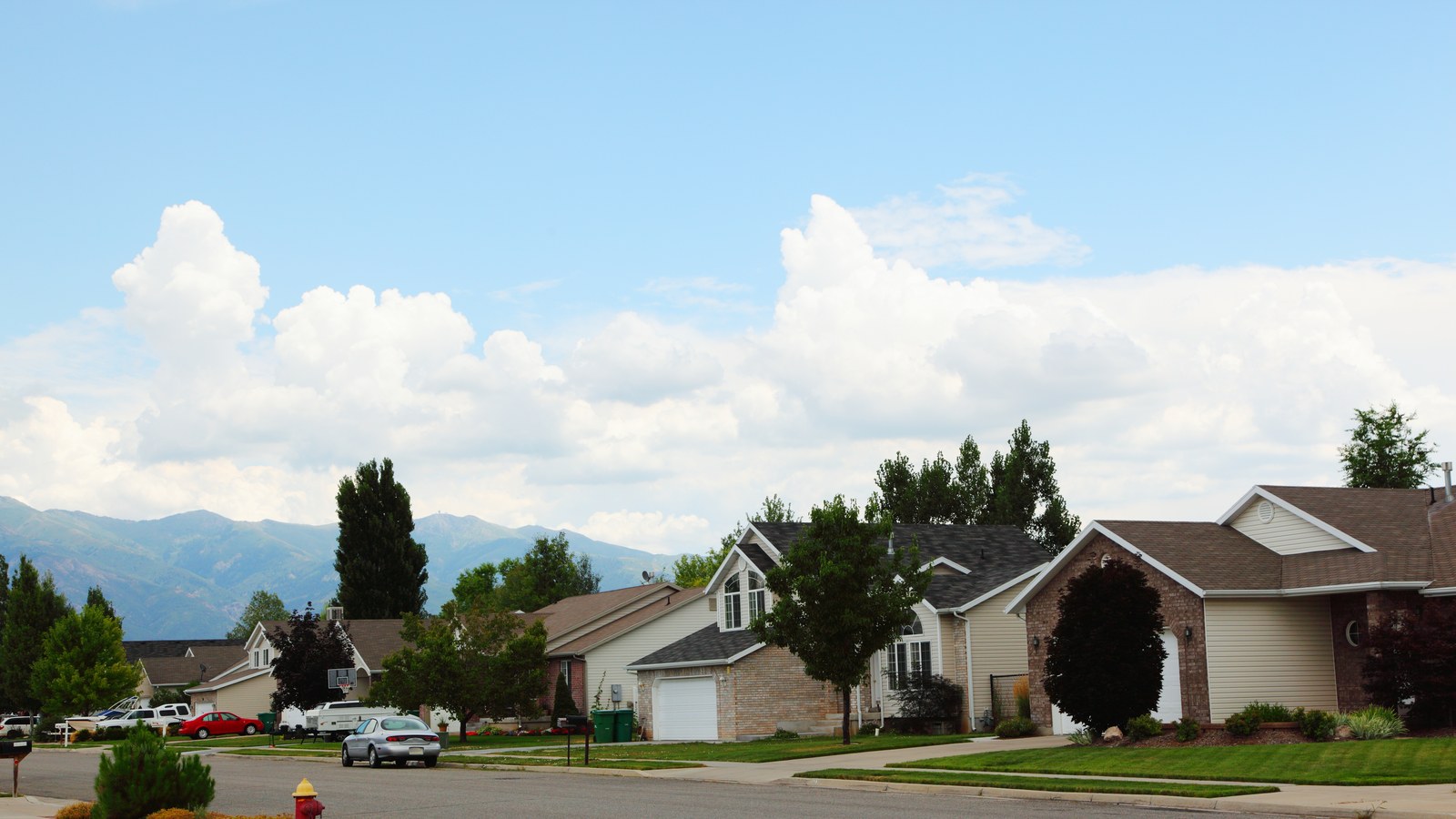
Photo: a suburban street in Layton, Utah, used as a general illustration of homes and equity. This is not a Texas property and not a listing. Photograph by D Sharon Pruitt / Pink Sherbet Photography, licensed under CC BY 2.0. Source: Wikimedia Commons. Cropped and resized. This is not a computer-generated image.
Clarity Home Lending is an Equal Housing Opportunity Lender. This article is not a commitment to lend. Rates and programs are subject to change and to credit and property approval. Payment and equity examples are illustrations only and are not a quote. This article is not legal or tax advice. Sources: Texas Constitution Article XVI, Section 50; 7 Tex. Admin. Code §153.5; Freddie Mac PMMS as of November 12, 2026; IRS Publication 936.